MIL-HDBK-61A: Scope
< Previous | Contents | Next >
1.3 Configuration Management Overview.
Configuration management embodies two concepts: (1) the configuration management of items and their defining technical data, referred to herein as configuration documentation; and (2) the application of CM principles to digital data in general. [Section 9] Because digital data management is critical to the control of configuration documentation and therefore to the configuration management of Weapon Systems, document management rules are integral to the CM process.
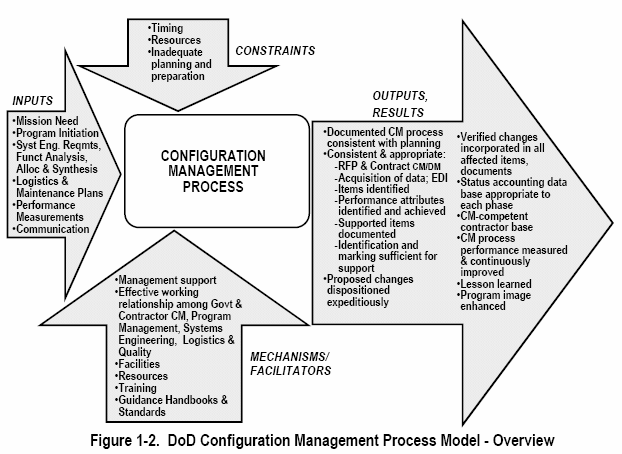
Configuration management is defined as a process for establishing and maintaining consistency of a product's performance, functional and physical attributes with its requirements, design and operational information throughout its life. Figure 1-2 is a top-level activity model depicting the CM process showing:
-
Inputs - Information needed to initiate and perform the process
-
Constraints - Factors or information that inhibits or puts limitations on the process
-
Mechanisms/Facilitators - Information, tools, methods, and technologies which enable or enhance the process
-
Outputs - Results that derive from the process or information that is provided by the process.
NOTE: Activity models in this handbook follow the above format, which is a simplification of the IDEF0 (Activity Model) protocol.
DoD Regulation 5000.2-R states the requirement for:
"....... a configuration management process to control the system products, processes and related documentation. The configuration management effort includes identifying, documenting and verifying the functional and physical characteristics of an item; recording the configuration of an item; and controlling changes to an item and its documentation. It shall provide a complete audit trail of decisions and design modifications."
The CM process encompasses:
-
Configuration items
-
Documents that define the performance, functional, and physical attributes of an item. These documents are referred to as configuration documentation.
-
Other documents which are used for training, operation and maintenance of an item
-
Associated and interfacing items that are used for training, operation, or maintenance of the configuration item.
The CM process is embodied in rules, procedures, techniques, methodology and resources to assure that:
-
The configuration of the system and/or item (its attributes) are documented. [Section 5]
-
Changes made to the item in the course of development, production and operation, are beneficial and are effected without adverse consequences. [Section 6]
-
Changes are managed until incorporated in all items affected. [Sections 6, 7 and 8]
CM is applied to defense material, whether hardware or software, that are designated as "systems" and "configuration items." Systems generally refer to the level at which major defense acquisitions are defined and managed. A configuration item (CI) may be an individual item, or may be a significant part of a system or of a higher-level CI. It is designated at an appropriate level for documenting performance attributes and managing changes to those attributes. The CI concept s has confused some people into thinking that the level at which CIs are designated is the point where configuration management stops. In reality, the CI level is where configuration management really begins; the process encompasses, to some degree, every item of hardware and software down to the lowest bolt, nut and screw, or lowest software unit. This does not mean that the acquiring activity, the prime contractor, or even subcontractors have visibility or configuration control authority over every part. Rather it means that some organization within either the supply chain or the standardization process has configuration documentation and change control responsibility for each part.
The attributes of configuration items are defined in configuration documentation. Configuration baselines are established to identify the current approved documents. Configuration items are uniquely identified. They are verified to make sure they conform to, and perform as defined in, the configuration documentation.
Whenever a change is contemplated to an item, the effect of that change on other items and associated documents is evaluated. Changes are systematically processed and are approved by the appropriate change control authority.
Change implementation involves update and verification of all affected items and documentation.
Information about item configuration, document identification and status, and change status is collected as activities associated with the CM process occur. This configuration status accounting information is correlated, maintained, and provided in useable form, as required.
The responsibility for the CM process and supporting activities is shared between the Government and the contractor and will usually vary according to the acquisition philosophy (performance or design-based) and according to the phase of the life cycle.
For correct application of this information, see NOTE on Contents page